
Another poorly argued article that attempts to sway readers to an opinion based on emotion rather than logic.
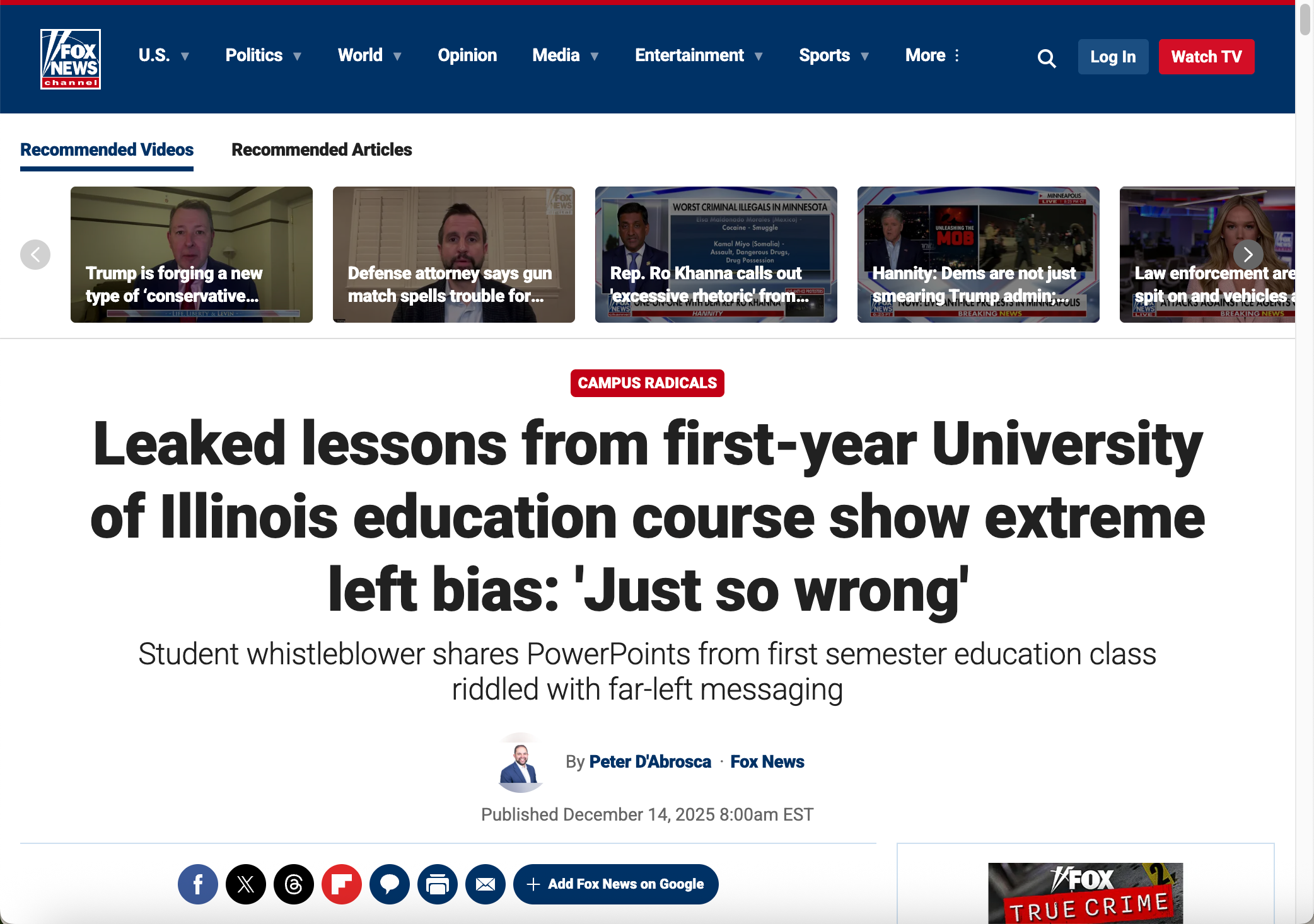
This analysis examines the Fox News article “Leaked lessons from first-year University of Illinois education course show extreme left bias: ‘Just so wrong’” by Peter D’Abrosca.
Fallacy 1: Begging the Question (BQ)
“Leaked lessons from first-year University of Illinois education course…”
Why this is a fallacy: Course materials at a public university aren’t secret documents. The word “leaked” assumes something was hidden or wrong before proving it. Normal class content gets framed as a scandal.
Begging the Question: Assuming your conclusion is true as part of your argument, instead of actually proving it.
Fallacy 2: Poisoning the Well (PW)
“…show extreme left bias: ‘Just so wrong’”
Why this is a fallacy: The headline tells you the course has “extreme left bias” before showing any evidence. You’re told how to feel before you see the facts.
Poisoning the Well: Attacking a source before presenting their argument, so the audience is already biased against it.
Fallacy 3: Appeal to Emotion (AE)
“‘Just so wrong’”
Why this is a fallacy: An emotional reaction is placed in the headline as if it were news. This sets the tone before readers see any facts. Feelings aren’t arguments.
Appeal to Emotion: Using emotional reactions instead of logical reasoning to make a point.
Fallacy 4: Poisoning the Well (PW)
“A whistleblower student provided Fox News Digital with PowerPoint presentations…”
Why this is a fallacy: “Whistleblower” means someone exposing illegal or unethical activity. Sharing class materials isn’t whistleblowing. The word frames the student as a hero before any wrongdoing is proven.
Poisoning the Well: Attacking a source before presenting their argument, so the audience is already biased against it.
Fallacy 5: Straw Man (SM)
“…teaches future educators to examine students through frameworks of racial and sexual oppression.”
Why this is a fallacy: The university says the course “examines how identity, power and privilege impact equity.” The article reframes this in scarier language. That’s not quoting — it’s rewriting.
Straw Man: Misrepresenting someone’s position to make it easier to attack.
Fallacy 6: Appeal to Motive (AM)
“…he talks about how you need to be political and really, what he meant was you need to be liberal.”
Why this is a fallacy: The student claims to know what the professor secretly meant. But the professor’s actual words aren’t quoted — just the student’s mind-reading. That’s not evidence.
Appeal to Motive: Dismissing an argument by questioning someone’s hidden intentions instead of addressing what they actually said.
Fallacy 7: Genetic Fallacy (GF)
“…cited the American Civil Liberties Union and National Education Association, claiming 2024 marked a ‘record year for anti-LGBT+ legislation.’”
Why this is a fallacy: The article names these organizations as if that alone discredits the claim. But is the claim about legislation true or false? That question is never addressed.
Genetic Fallacy: Judging a claim based on where it comes from, rather than whether it’s actually true.
Fallacy 8: Genetic Fallacy (GF)
“The presentation referenced the Human Rights Campaign and Trevor Project in materials encouraging educators to affirm LGBTQ+ identities.”
Why this is a fallacy: Same pattern: organizations are named as if listing them proves bias. No argument is made for why affirming students would be wrong — just that these groups support it.
Genetic Fallacy: Judging a claim based on where it comes from, rather than whether it’s actually true.
Fallacy 9: Appeal to Emotion (AE)
“I just think to push that on young children is just so wrong.”
Why this is a fallacy: “Just so wrong” is a feeling, not a reason. The student doesn’t explain what specifically is harmful or why. An emotional reaction is presented as if it were an argument.
Appeal to Emotion: Using emotional reactions instead of logical reasoning to make a point.
Fallacy 10: Straw Man (SM)
“I just think to push that on young children…”
Why this is a fallacy: This is a college course for adults training to be teachers. The course isn’t being “pushed on young children” — it’s teaching educators about these topics. That’s not the same thing.
Straw Man: Misrepresenting someone’s position to make it easier to attack.
Fallacy 11: False Dichotomy (FD)
“…focusing on ‘equity and justice’ rather than standardized best practices.”
Why this is a fallacy: This frames it as either/or: you get equity OR best practices. But why can’t a course teach both? The article never explains why these are opposites.
False Dichotomy: Presenting only two options when more possibilities exist.
Fallacy 12: Appeal to Emotion (AE)
“…helping students understand ‘privileged identities’ and ‘minoritized identities’…”
Why this is a fallacy: Scare quotes around academic terms suggest they’re silly or made-up. But the article never explains what’s wrong with these concepts — just that they sound suspicious.
Appeal to Emotion: Using emotional reactions instead of logical reasoning to make a point.
Fallacy 13: Cherry-Picking (CP)
One anonymous student is quoted throughout the entire article.
Why this is a fallacy: A class has many students. The article quotes just one — anonymously — and presents their view as the full story. Were other students asked? We don’t know.
Cherry-Picking: Selecting only the evidence that supports your conclusion while ignoring the rest.
Fallacy 14: Cherry-Picking (CP)
Slides from weeks 5 and 12 are quoted from a full-semester course.
Why this is a fallacy: A 15-week course is reduced to a few selected slides. Without seeing the full curriculum, readers can’t judge if the course is actually unbalanced.
Cherry-Picking: Selecting only the evidence that supports your conclusion while ignoring the rest.
Fallacy 15: Red Herring (RH)
“The university defended the course, stating it ‘examines how identity, power and privilege impact equity in education…’”
Why this is a fallacy: The university’s response appears at the end but is never engaged with. The article doesn’t explain why this defense fails — it just moves on, creating false balance.
Red Herring: Including irrelevant information that distracts from the main issue or creates an illusion of fairness.
Analysis Summary
Most Prevalent Patterns
- Poisoning the Well — Sources are labeled before their claims are presented
- Genetic Fallacy — Claims dismissed based on who made them, not whether they’re true
- Appeal to Emotion — Feelings presented as arguments
- Cherry-Picking — One student, selected slides, no broader context
Apparent Functional Intent
Mobilize. The article is structured to generate outrage rather than inform. Evidence is thin (one anonymous student, a few slides), but framing is heavy.
Remember: Spotting bad logic doesn’t mean the conclusion is wrong — only that the reasoning doesn’t support it.
Want to analyze articles for logical fallacies yourself? Get the free AI prompt that was used to conduct this analysis. Works with Claude, ChatGPT, or any AI assistant.