

EdTech Marketing Strategy Overhaul: How KMT Rebuilt a $20MM Company’s Entire MarTech Stack
A six-month transformation from wasted martech budget to an integrated system that’s still driving growth seven years later
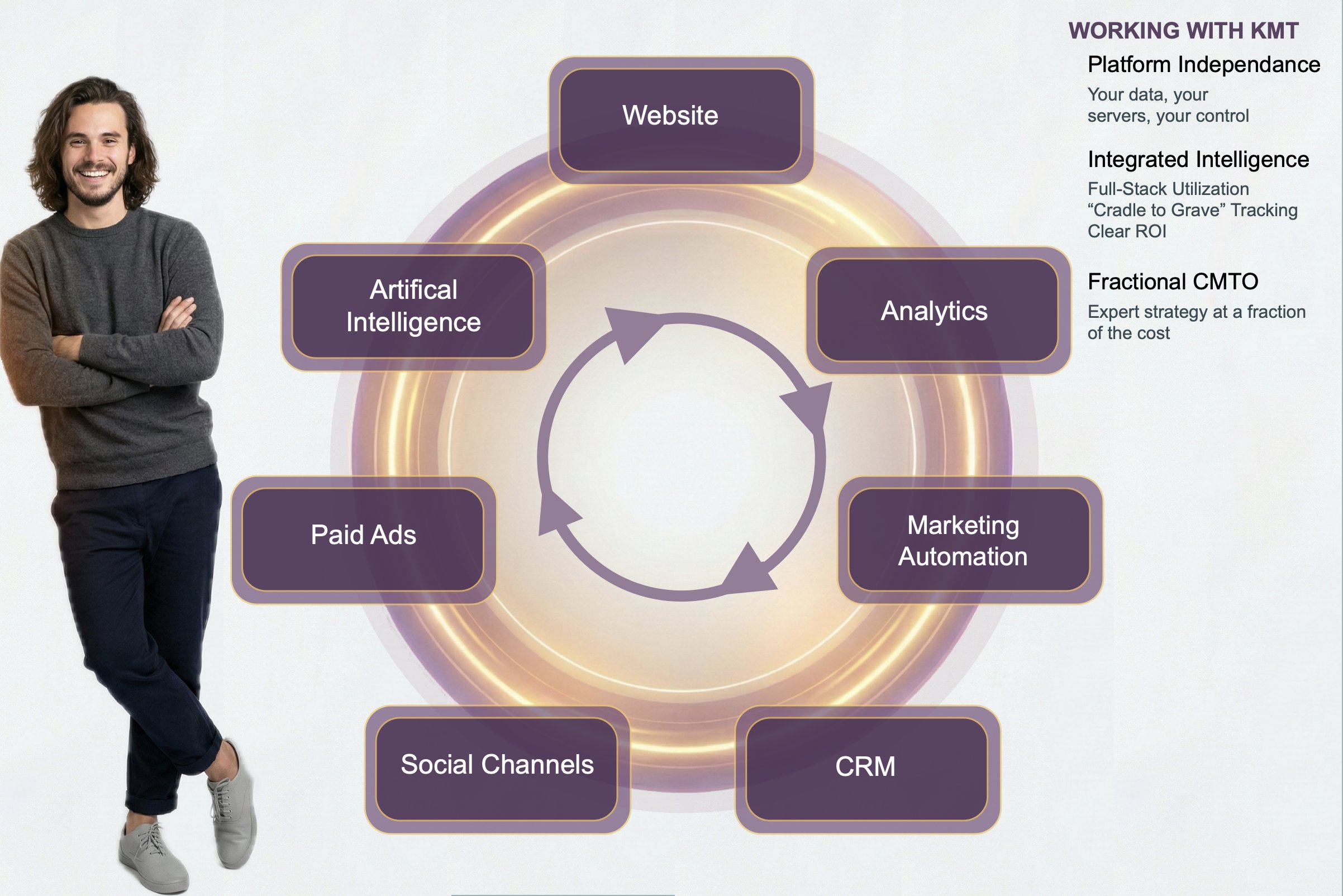
An ed-tech company specializing in CRM solutions for higher education had all the right tools – a modern website platform, Google Analytics, Pardot for marketing automation, and Salesforce as their CRM. On paper, their martech stack looked solid. In reality, they were living the nightmare that Gartner documents: wasting roughly 67% of their marketing technology budget on features they weren’t using and data they couldn’t trust. What they needed wasn’t more tools – they needed an edtech marketing strategy that connected everything together.
When they reached out to Keystone Marketing Technology, they knew something wasn’t working. What they didn’t know was how deeply their systems were working against each other – or how much money they were leaving on the table.
THE BEFORE: Living the “67% Waste”
Analytics That Couldn’t Answer Basic Questions
The company’s Google Analytics was essentially useless for decision-making. Why? Because their current customers and their prospects all used the same homepage. Customers would visit the site to click the login button and access their accounts. This traffic completely polluted the analytics data, making it impossible to understand how actual prospects were behaving on the site.
They couldn’t answer fundamental questions: Which pages do prospects visit before requesting a demo? How long do serious buyers spend on the site? Where do people drop off? The data was there, but it was buried under the noise of existing customer logins.
Marketing Automation Doing Email’s Job
The company had invested in Pardot – Salesforce’s marketing automation platform – specifically because they used Salesforce as their CRM and assumed the integration would be seamless. They were paying premium prices for enterprise-grade marketing automation.
But here’s what they were actually doing with it: sending emails. Like many organizations, they’d invested in enterprise marketing automation but were using it primarily as an email platform – utilizing a fraction of its capabilities. No lead scoring was in place. Behavioral tracking wasn’t configured. Nurture campaigns based on engagement hadn’t been built out yet. The infrastructure was there; it just hadn’t been activated.
Like many organization, they were literally wasting 90% of what they were paying for.
Lead Generation Without Lead Management
Their primary lead generation strategy was simple: people would read a blog post, think it was interesting, and sign up for the newsletter. That person would then enter their systems as a “lead.”
But here’s the problem – someone reading your blog about higher education trends is not the same as someone researching your product because they need to solve a problem. They had no way to distinguish between casual readers and serious prospects. No lead scoring system. No way to identify when someone was showing buying intent versus just consuming content.
Every newsletter signup looked the same in their systems, which meant sales was either chasing people who were just blog readers, or ignoring everyone because they couldn’t tell who was actually worth talking to.
The CRM Confusion: Leads, Contacts, and Nobody Knew the Difference
This is where things got truly messy. Again, like many organizations, they were struggling with the eternal question: when is someone a “lead” in Pardot versus a “lead” in Salesforce versus a “contact” in Salesforce?
They didn’t have a clear answer, which meant different people made different decisions. Some team members would create a Salesforce contact the moment someone downloaded a brochure. Others kept people in Pardot indefinitely. There was no consistent logic, no clear progression from one stage to another.
The result? Salesforce was cluttered with “contacts” and “opportunities” for people who had barely engaged. Sales reps were wasting time chasing people who had simply clicked one thing. And genuine prospects were getting lost in the noise.
A Website That Talked About Itself
When I looked at their homepage, I saw that it was very company-centric; lots of information about the company’s history, values, and background, and how good their product is. Very little substantive information about what their products actually did or how they helped higher education institutions.
This matters enormously because research shows roughly 75% of B2B buyers arrive at a vendor’s website having already done significant independent research. They’re educating themselves, comparing options, trying to determine fit before they ever contact sales. The company’s website wasn’t designed to help prospects learn – it was designed to talk about the company.
THE DISCOVER PHASE: Listen First, Diagnose Second
Understanding the Business (Not Just the Tech)
When I start working with a client through KMT’s methodology, I spend about 80% of my time listening in the beginning. Not just about their technology – about their business, their customers, their sales process, how they think about prospects, what their goals are, what their constraints are.
In this case, the Chief Revenue Officer and CEO had worked with me on another project and appreciated this approach. They weren’t looking for someone to come in with pre-baked solutions. They wanted someone who would understand their specific situation first.
I learned about their product suites, their typical sales cycle, how their team worked, what their staff’s technical capabilities were, and what their budget constraints looked like. This context was essential for everything that came later.
Auditing the Entire Stack
Then came the systematic audit. I traced the entire prospect journey from first website visit through to closed customer:
- How was the website structured? What was the user experience? What was the messaging strategy?
- Where were prospects entering the system? What forms existed? What happened to that data?
- How was Google Analytics configured? What was being tracked? What reports existed?
- How was Pardot being used? What automations were running? How was data flowing to Salesforce?
- What was happening in Salesforce? How were leads and contacts managed? What was the sales process?
Identifying the Disconnects
The audit revealed what I suspected: they didn’t have a martech stack problem. They had a strategy problem that was manifesting as a technology problem.
Nobody had ever mapped out the ideal prospect journey. Nobody had defined what a “qualified lead” actually meant for their business. Nobody had established clear criteria for when someone should move from marketing automation to the CRM. The tools were there, but they weren’t connected by strategic thinking – which is exactly what an effective edtech marketing strategy should provide.
THE BUILD PHASE: Building an Integrated EdTech Marketing Strategy
Rebuilding the Website with Marketing Strategy
The website redesign wasn’t about making it prettier. It was about respecting how B2B buyers actually behave in 2025.
We restructured the entire homepage around solutions and benefits rather than company background. We organized their product information to make self-education easy, reducing what I call “neuro taxation” – the mental effort required to find what you’re looking for.
Instead of generic marketing messages, we focused on clearly explaining what each product suite did and what outcomes it delivered. We made “Request a Demo” the primary call-to-action, giving prospects a clear next step once they’d learned what they needed to know.
The goal was simple: help prospects educate themselves efficiently, so that when they did reach out for a demo, they were informed and genuinely interested. This website foundation became the first touchpoint in a comprehensive edtech marketing strategy.
Fixing Analytics to See What Actually Matters
The analytics fix was technically simple but strategically crucial. We implemented a custom event in Google Analytics that fired whenever a current customer logged in.
This one technical change created clean segmentation. Suddenly, customer activity and prospect activity were separated. The company could finally see their actual prospect behavior – which pages potential buyers visited, how long they spent learning about different solutions, where drop-offs happened, what paths led to demo requests.
For the first time, their analytics data was actually useful for understanding and optimizing the prospect experience.
Right-Sizing Marketing Automation
Here’s where platform-agnostic thinking became valuable. Pardot is a powerful tool, but it’s also complex and expensive. Given the company’s team size, their technical capabilities, and the fact that they weren’t actually leveraging the deep Salesforce integration anyway, I recommended switching to HubSpot.
This wasn’t about HubSpot being “better” in some absolute sense. It was about finding the right fit. HubSpot would be easier for their team to use, more intuitive to set up, and significantly less expensive – while still giving them real marketing automation capabilities they weren’t currently using.
We migrated from Pardot to HubSpot and then got to work building what they’d been missing: actual marketing automation.
Creating a Real Lead Journey
This is where strategy and technology finally came together. We established a clear philosophy: leads stay in marketing automation until they demonstrate genuine buying intent. Only then do they move to Salesforce as contacts.
Here’s how it worked:
In HubSpot (Marketing Automation):
- Every prospect who engaged with the website entered HubSpot, whether they downloaded content, signed up for the newsletter, or requested information
- We built lead scoring based on meaningful behaviors: visiting the pricing page, viewing implementation information, watching product videos, returning multiple times, spending significant time on solution pages
- We created nurture campaigns that sent relevant content based on what people had engaged with
- We tracked everything – email opens, link clicks, website visits, content downloads
The Qualification Threshold:
- A prospect only moved from HubSpot to Salesforce when their lead score indicated genuine interest – they’d visited the right pages, engaged with content over time, demonstrated patterns that matched past customers who actually bought
In Salesforce (CRM):
- Only qualified contacts entered Salesforce, never leads (I don’t believe in using “leads” in CRMs – it creates confusion)
- Sales reps could trust that anyone in their pipeline had been vetted by behavior, not just by filling out a form
- The CRM stayed clean and focused on actual opportunities
This solved the old problem where someone downloading a brochure would instantly become a contact and an opportunity in Salesforce. Now, downloading a brochure meant you entered HubSpot’s nurture stream. If you then visited the pricing page three times, watched implementation videos, and spent 20 minutes reading case studies – then you moved to Salesforce as a qualified contact worth a sales conversation.
EdTech Marketing Strategy: Integration as the Foundation
None of this worked in isolation. The website redesign created better lead capture with clearer value propositions. Google Analytics tracked how prospects engaged. HubSpot received those leads, tracked continued engagement, scored behavior, and nurtured over time. Salesforce received only the prospects who’d demonstrated real intent.
Each piece informed and improved the others. That’s what an integrated edtech marketing strategy actually looks like.
THE RESULTS: An Integrated System That Works
Still Running Seven Years Later
Perhaps the best proof of getting the foundation right: seven years later, the company is still using these systems. The website structure has remained largely unchanged. HubSpot and Salesforce are still integrated with the same basic lead flow logic. When something works for seven years in marketing technology – a field where tools and tactics change constantly – you know the strategic thinking was sound.
Clean Data, Finally
Once we separated customer logins from prospect behavior in analytics, the company could actually see what was happening. They could measure which website changes improved prospect engagement. They could see which content topics attracted serious buyers versus casual readers. They could optimize based on real data instead of guessing.
Lead Quality Over Lead Quantity
The shift was dramatic. Instead of treating every newsletter signup as a potential opportunity, they were now having conversations with prospects who had educated themselves, demonstrated interest through their behavior, and were ready for substantive discussions about implementation.
Sales wasn’t wasting time chasing blog readers anymore. The leads that made it to Salesforce were genuinely qualified, which meant higher conversion rates and shorter sales cycles.
Actual ROI from Marketing Automation
By moving from Pardot to HubSpot, they reduced costs a bit. But more importantly, Hubspot was the right platform for the staff’s level of capability (at the time); they were finally using marketing automation for what it’s designed to do – nurture prospects over time, track engagement, score based on behavior, and identify buying intent automatically.
They went from wasting 90% of their marketing automation investment to actually leveraging the platform’s capabilities. That’s the difference between renting a Ferrari to drive to the grocery store versus actually using it for what it’s built to do.
Cost Savings and Better Performance
By eliminating the Pardot expense and right-sizing to HubSpot, they saved money while gaining functionality they were actually using. By cleaning up Salesforce and keeping it focused on qualified contacts, they improved sales efficiency. By fixing the website and analytics, they could make data-driven decisions instead of operating blind.
The whole was greater than the sum of its parts – which is exactly what happens when you integrate your martech stack with strategic thinking instead of just bolting tools together.
Key Takeaways
- Strategy must come before tools. The company had all the right technology but no coherent strategy for how the pieces should work together. Technology can’t fix a strategy problem, but good strategy can transform how technology performs. The first question should always be “what’s the ideal prospect journey?” not “what tools should we buy?”
- Most organizations waste their marketing automation investment. If you’re using HubSpot, Pardot, Marketo, or similar platforms to primarily send emails, you’re wasting 80-90% of what you’re paying for. Marketing automation should track behavior, score engagement, nurture over time, display dynamic content, and identify buying intent. If it’s not doing those things, you’re overpaying for a glorified email platform.
- Don’t use “leads” in your CRM. The confusion between marketing automation leads, CRM leads, and CRM contacts creates more problems than it solves. My recommendation: keep everyone in marketing automation as leads until they’re qualified, then move them to the CRM as contacts. This eliminates an entire category of confusion and keeps your CRM focused on actual opportunities.
- Analytics are worthless if you can’t trust the data. Mixing different audiences – customers, prospects, employees, partners – in your analytics makes the data meaningless. Take the time to segment properly so you’re actually measuring what matters. A simple custom event or proper UTM parameter strategy can make the difference between useful insights and misleading noise.
- Platform-agnostic thinking saves money and improves results. The “best” tool is the one that fits your team’s capabilities, your budget, and your actual needs – not the one with the most features or the biggest brand name. Sometimes the right answer is switching to a simpler, cheaper platform that your team will actually use effectively.
- Integration is about strategy, not just APIs. Yes, tools need to talk to each other technically. But real integration means each piece of your martech stack serves a clear purpose in a coherent prospect journey. When you can explain why each tool exists and how it connects to what comes before and after it, you have true integration. This holistic view separates effective edtech marketing strategy from simple tool implementation.
Technologies & Skills Featured
Google Analytics (custom event tracking), HubSpot (marketing automation, lead scoring, CRM integration), Salesforce (CRM), Pardot (evaluation and migration), website strategy and UX, marketing automation strategy, lead management systems, martech stack audit and optimization, edtech marketing strategy, higher education marketing
Ready to Optimize Your Marketing Stack?
Stop wasting 67% of your MarTech budget. Get the expertise you need to integrate, optimize, and prove marketing ROI.
LEARN MORE
CONTACT
eric@keystonemartech.com
Connect
SERVING
Located in Philadelphia, Providing Services Worldwide