

What is Marketing Technology? A Plain-English Guide
“Marketing Technology” represents the ecosystem made up of your marketing-related platforms. Making it a system that works together instead of independently is the next evolution in your marketing engineering efforts.
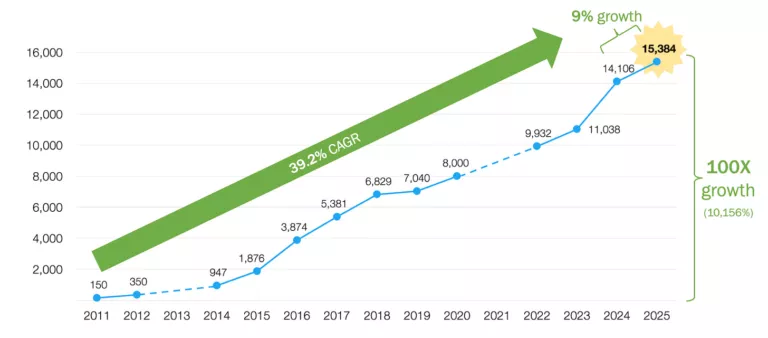
MarTech Landscape Growth Since 2011 (courtesy of chiefmartech.com)
If you’re a business leader or marketing director, you’ve likely felt the ground shift beneath your feet over the last decade. The way we reach customers has changed, and the tools we use have multiplied at a dizzying rate. This has led to a new, critical discipline sitting at the intersection of marketing and IT: marketing technology.
But what is it, really?
It’s a fair question, and one that often comes with a bit of baggage. Many assume that needing to focus on marketing technology, or “MarTech,” means someone has done something wrong. The reality is quite the opposite. The need for a MarTech strategy exists precisely because so many companies have done things right over the years; they’ve adopted new tools and platforms as they emerged to meet immediate business needs.
The problem is that this often happens one piece at a time, without a blueprint. Now, it’s time to take a step back, look at all those pieces, and make sure they’re finally talking to each other.
What is Marketing Technology (MarTech)?
At its core, marketing technology refers to the range of software and tools that marketers use to plan, execute, manage, and measure their campaigns and other marketing efforts. It’s the engine running behind the scenes of every modern marketing department.
Think about all the things you do in a given week:
- Send an email newsletter
- Update your website
- Post on social media
- Run digital ads
- Analyze website traffic
- Manage customer relationships
Each of these activities is powered by a specific piece of technology. The effective use of technology in marketing is no longer optional; it’s the foundation upon which successful strategies are built. The goal of a focused MarTech strategy is to make sure these tools work together as a cohesive system, not as a collection of isolated islands.
The ultimate objective is to create a seamless flow of data that allows you to connect an anonymous first-time visitor on your website all the way through their journey to becoming a loyal customer
This complete picture can only be achieved when the relationship between marketing and technology is intentionally designed to support your specific business goals.
Understanding the Marketing Technology Stack
When we talk about all the different tools a company uses, we’re referring to its marketing technology stack. This is simply the collection of all the MarTech software used to execute your marketing activities.
For most organizations, this stack wasn’t built; it just sort of… happened. This is what I call the “accidental stack,” and the story is almost always the same.
- The Website: A new company needs a web presence, so they spin up a website on a platform like WordPress.
- The Analytics: They need to see who is visiting the site, so they install Google Analytics because it’s powerful and free.
- The Email List: They want to build an audience, so they sign up for an email marketing service like Mailchimp.
- The “Upgrade”: Someone tells them they need “marketing automation,” so they invest in a more complex platform. But without a strategy, they generally just use it as a more expensive email platform.
- And, of course, you’re going to need Salesforce: Someone else says you need to have Salesforce, or another proprietary CRM for sales, but so often it just gets used as an incredibly expensive “rolodex”.
Each step made perfect sense at the time. The company had a need, and it found a tool to fill it. But the result is a set of disconnected systems that don’t share data. Your website analytics don’t talk to your email platform, and your email platform doesn’t talk to your sales CRM.
This is more than just an inconvenience; it’s incredibly wasteful. According to reports from Gartner, up to 67% of the investment in marketing technology is wasted. Why? Because these powerful platforms are not integrated or used to their full potential.
A strategic approach to marketing technology stacks moves away from this accidental collection of tools. It involves a deliberate process of understanding the platforms available, the data integration opportunities, the objectives of the business, and the knowledge of the staff who will use the tools. The goal is to create a system that pulls everything together, giving business owners and marketing directors a holistic view so they can make data-driven decisions with confidence.
Marketing Technology in the Digital Age
The explosion of digital marketing technology has fundamentally changed the game. There are more customer touchpoints than ever before: social media, ads, organic search, email, review sites, and more. Each touchpoint generates data, and without a way to connect that data, you’re flying blind.
This is where a cohesive MarTech strategy becomes a competitive advantage. It’s about transforming raw data into actionable intelligence.
Story Time
I once worked with an organization that sold online courses. They were spending a significant amount of money with an advertising agency, and by all accounts, the agency was doing a good job. They provided detailed reports showing how many people clicked on an ad and filled out a form on the website. In the agency’s world, that form-fill was a “conversion,” and the campaign looked like a success.
Based on this, the organization used a rough calculation. They assumed, “Well, about 50% of the people who come from ads fill out a form, so we’ll attribute 50% of our sales to that channel.”
They were making major budget decisions based on a guess.
Our first step was to connect their systems. We integrated their ad platforms with their website analytics and, most importantly, imported data from their e-commerce platform where the actual purchases happened. We built a system that could follow a single person from their first ad-click all the way through to their final purchase.
The results were stunning. We discovered that only a very, very small fraction of actual purchasers had ever clicked on an ad. The channel they thought was a primary driver of sales was, in reality, one of their least effective. Their data was incomplete, and it was leading them to the wrong conclusions.
Armed with this new, complete picture, they were able to redirect their marketing budget away from the underperforming ads and into channels that were proven to generate sales. This is the power of mastering digital marketing and technology; it replaces assumptions with certainty.
The Evolution of MarTech: From Inbound Marketing to Scott Brinker
The concept of marketing technology didn’t appear overnight. Its roots can be traced back to the rise of “inbound marketing,” a term popularized by HubSpot in the mid-2000s. The inbound methodology shifted the focus from “renting” attention through ads to “owning” it by creating valuable content that attracted customers naturally.
This created a new set of needs. Marketers needed tools for blogging, SEO, social media management, and lead nurturing. This demand spurred the creation of all-in-one marketing automation platforms designed to manage these interconnected activities.
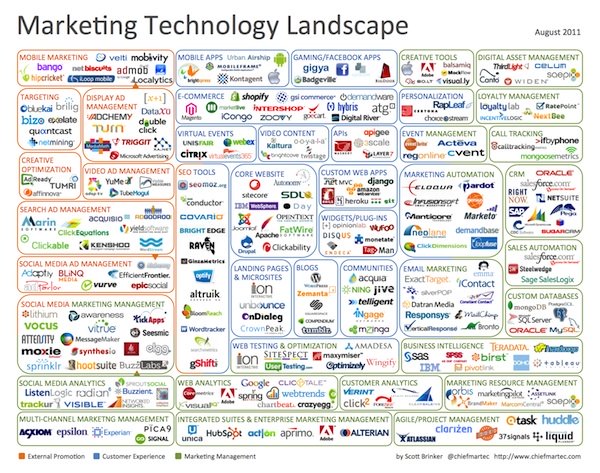
Around the same time, a software executive named Scott Brinker started a blog called chiefmartech.com. He was one of the first people to recognize that the proliferation of these marketing tools represented a new and distinct professional discipline. He coined the term “MarTech” and, in 2011, published the first Marketing Technology Landscape, a graphic that attempted to map out all the vendors in the space.
That first graphic included about 150 companies:
Today, it features nearly 10,000:
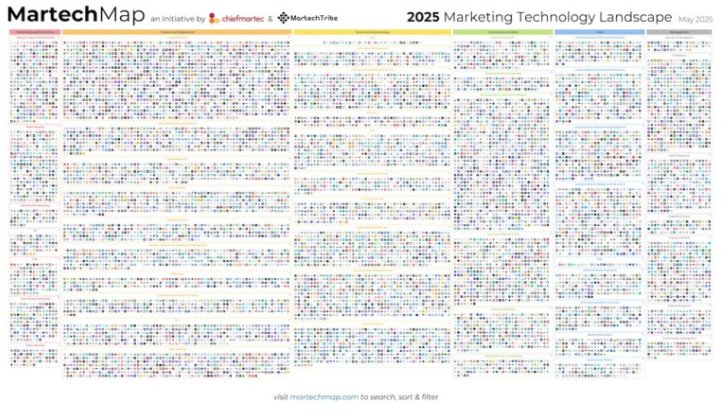
Brinker’s work gave a name and a face to the chaos many marketers were feeling. It validated the idea that managing marketing technology was a real job and a complex challenge. The landscape he documents is the very reason why so many companies end up with accidental, fragmented stacks. There are simply too many options, each promising to be a silver bullet.
The evolution from simple email tools to the sprawling MarTech landscape of today highlights the core challenge: the technology has outpaced the strategy.
Bringing It All Together
Marketing technology is not about the tools themselves. It’s about building a system that serves your business. It’s about breaking down data silos to see the full customer journey, ending the waste of unused software, and empowering your team to make decisions based on truth, not guesswork.
If your marketing tools feel more like a tangled mess than a streamlined system, you’re not alone. It might be time to get a clear, strategic view of your technology.
Ready to Optimize Your Marketing Stack?
Stop wasting 67% of your MarTech budget. Get the expertise you need to integrate, optimize, and prove marketing ROI.
LEARN MORE
CONTACT
eric@keystonemartech.com
Connect
SERVING
Located in Philadelphia, Providing Services Worldwide